

Apple’s next entry-level iPad may not be the flashiest iPad update of 2027, but it could be one of the most important. The affordable model is reportedly set to receive a faster chip that will finally bring support for Apple Intelligence.
The current iPad, released in March 2025, remains a capable tablet for students, families and everyday users, but it is now the only iPad in Apple’s lineup that doesn’t support Apple Intelligence. A new model expected in early 2027 should address that limitation, potentially with an A18 or A19 chip.
Other changes are expected to be relatively modest, with Apple likely to retain the current design and LCD display while focusing on performance and connectivity improvements.
Here’s everything we know so far about the 2027 iPad, including its expected release date, price, design, chip and other specs.
| 2027 iPad predictions | 2025 iPad | |
|---|---|---|
| Launch date | Early 2027 | March 2025 |
| Processor | A18 (maybe A19) | A16 |
| RAM | 8GB (rumored) | 6GB |
| Wi-Fi | Wi-Fi 7 | Wi-Fi 6 |
| Bluetooth | Bluetooth 6 | Bluetooth 5.3 |
| Apple Intelligence | Yes | No |
| Design | Unchanged | Unchanged |
Apple’s next entry-level iPad is expected to arrive in the first half of 2027, according to Bloomberg’s Mark Gurman. As outlined in our November 2 report, Gurman expects Apple to announce updates to the standard iPad, iPad Air, and iPad Pro during that period.
Earlier reporting suggested the entry-level model could arrive as early as the first quarter of 2027, followed by updates to the iPad Air, iPad Pro, and Apple Pencil in the spring. The latest forecast gives a broader window extending through June, but a January-to-March launch still remains possible.
The timing has shifted from an earlier forecast that placed the new entry-level iPad in the iOS 26.4 release window back in May 2026. The reasons why Apple did not introduce a replacement during that period remain unclear. Chip availability and software readiness may have influenced its plans.
Unless you can find a really good deal on the current-generation iPad, we recommend waiting for the 2027 iPad if you’re considering an upgrade. The next-generation iPad is expected to deliver a meaningful upgrade with a faster chip, more RAM, and support for Apple Intelligence, making it a much more future-proof choice.
The next iPad is expected to use either the A18 or A19 chip, with conflicting evidence pointing to both possibilities. Macworld has seen internal Apple code specifically linking the new J581 and J582 models to the A19, while Bloomberg’s Mark Gurman reported in March 2026 that Apple had prepared an A18-powered model. It’s possible Apple has tested multiple configurations or subsequently changed its plans.
The A18, which debuted in the iPhone 16 and 16 Plus in 2024, would be a substantial upgrade over the A16 in the current iPad. Crucially, it would also bring the 8GB of RAM needed to support Apple Intelligence.
However, there is strong evidence for the A19 as well. As we reported in December 2025, leaked Apple code linked the J581 and J582 iPad models to the A19 chip used in the iPhone 17.
Until further information emerges, either chip remains plausible. Reports of A18 Pro shortages, linked to demand for the MacBook Neo, shouldn’t necessarily affect supplies of the standard A18.
We have seen internal-code that indicates the new iPad will contain Apple’s N1 wireless chip. First introduced with the iPhone 17 lineup, the N1 handles Wi-Fi, Bluetooth, and Thread connectivity. Its inclusion could bring Wi-Fi 6E or Wi-Fi 7 and Bluetooth 6.x, upgrading the current iPad’s Wi-Fi 6 and Bluetooth 5.3.
For cellular models, Apple will likely use its in-house C1 modem (or a variant of it), continuing its shift away from third-party suppliers while improving efficiency and integration.
Apple Intelligence introduces a range of AI-powered features designed to enhance creativity, productivity, and real-time communication, including:
These features require at least 8GB of RAM and a more powerful Neural Engine, which means Apple Intelligence is currently limited to M-series iPads (Air and Pro) and the A17 Pro iPad mini.
By contrast, the standard iPad with the A16 chip (released in March 2025) does not support Apple Intelligence. This is a notable limitation for long-term value, especially as future versions of iPadOS are expected to rely increasingly on AI-driven features.
The next entry-level iPad is expected to retain an LCD screen. Although the iPad mini gained OLED in late 2026 and the iPad Pro already offers it, there is no indication that the next standard iPad will receive the same upgrade.
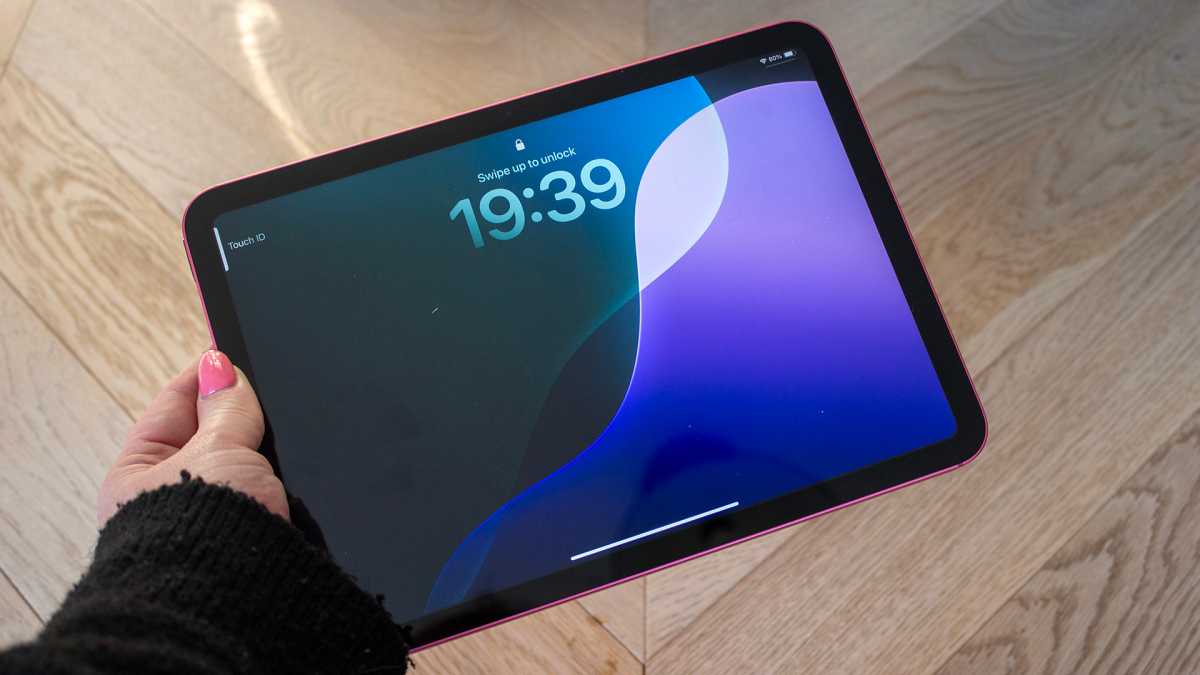
We expect a display matching the current A16 model: an 11-inch Liquid Retina screen with a resolution of 2360 by 1640 pixels, 500 nits of brightness and a 60Hz refresh rate.
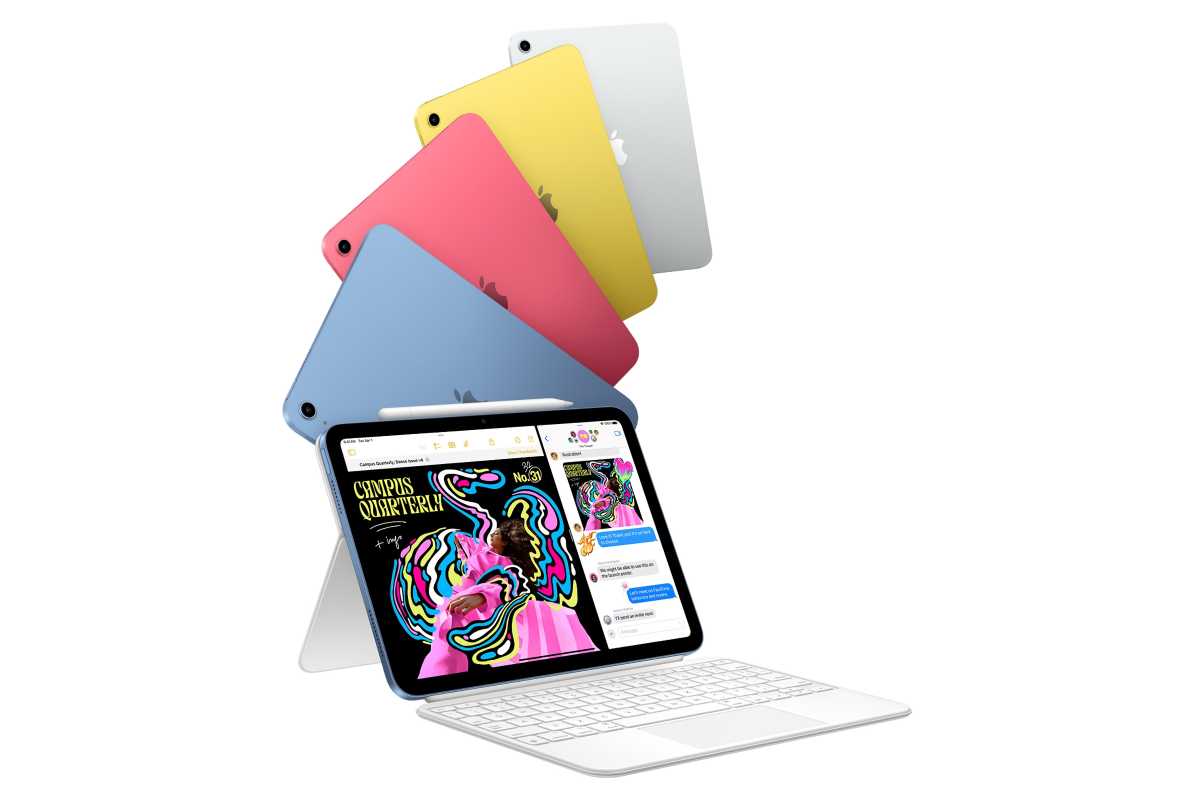
Apple currently offers the iPad in four colors.
Apple
The next entry-level iPad is also expected to have the same dimensions: 9.79 x 7.07 x 0.28 inches (248.6 x 179.5 x 7 millimeters) and weigh 1.05 pounds (477 grams).
We haven’t heard anything about new colors, but since Apple hasn’t changed the color palette (blue, pink, yellow, silver) since its original release, it’s possible we get a couple of new options.
Britta O’Boyle
The current iPad has two 12MP cameras, with the front ‘FaceTime’ camera having support for Center Stage. Apple isn’t expected to make changes to the camera for the upcoming iPad.
However, the company did change the Centre Stage camera with the arrival of the iPhone 17, and the new ‘square’ 18MP camera could be used on the front of the new iPad, but there are no reports indicating this will be the case.
This front-facing camera has a larger, square sensor that supports automatic subject framing, orientation-agnostic capture, and advanced video features. On the iPad the 18MP camera could translate to improved video quality. However, current iPads already support smart framing during video calls so that aspect of the design may not be necessary.
After launching at $449 in 2022, Apple cut the price of the entry-level iPad to $349 in May 2024, then doubled the starting storage from 64GB to 128GB with the 11th-generation model. However, in June 2026, Apple raised the price back to $449 due to supply-chain shortages. That makes the current A16 model considerably less attractive with a more capable, AI-ready replacement expected in early 2027. It’s also possible Apple could raise the price again when the new model arrives.


