
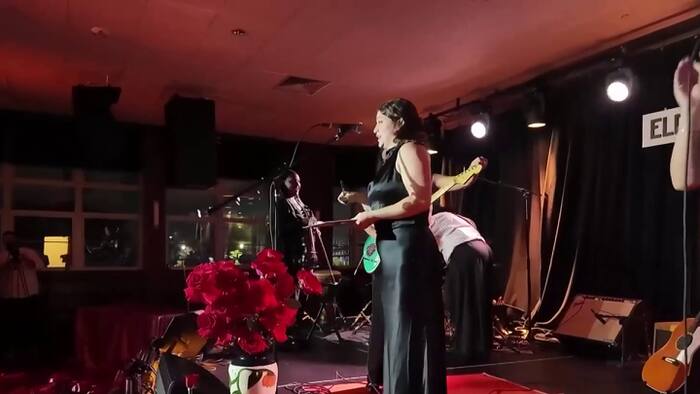
Before Sara Van Buskirk stepped into a room full of people supporting her music, she had a moment when she wanted to give up.
Asked whether the pressure of being an independent musician had ever brought her to that point, the Houston singer-songwriter did not have to reach far into her past.
“Yeah. In the shower before this event,” Van Buskirk said.
The event was her inaugural “I’m With You” gala, a fundraiser to help finish her upcoming album. But the reason for bringing everyone together went beyond one recording: Van Buskirk wants to create the kind of support she and other independent musicians need to keep working.
Next year, she wants to do it for another artist.


For audiences, a night of live music can look effortless: a song, a smile, a room full of people having fun. Behind it are studio bills, rehearsals, promotion, negotiations and the uncertainty of whether enough people will buy a ticket.
Van Buskirk has made music her livelihood, helping support her partner and son. Keeping that livelihood going, she said, takes more than talent.
“But it’s really knowing your worth and then telling people what you’re worth and believing it and fighting for it,” Van Buskirk said.
Houston has helped shape some of music’s biggest names, including Beyoncé, Lizzo and ZZ Top. But building a music career here does not always mean earning enough to live on.
Findings from the 2026 Greater Houston Artists Study, conducted by Fresh Arts in partnership with SMU DataArts with funding from Houston Endowment, illustrate the financial pressures.
The study gathered responses from 1,008 working artists across multiple disciplines, not just music. Among its findings:
- 57% reported less than $50,000 in annual personal income from all sources, including other jobs.
- 47% of respondents answering the income-source question earned less than one-quarter of their personal income from artistic practice; 29% earned all their personal income through art.
- Half did not believe organizations in their community fairly compensate the artists they work with.
The findings describe income and working conditions rather than the percentage of musicians who achieve mainstream fame. They also show that, for many respondents, artistic work accounts for only a small share of their income.
For Van Buskirk, independence means keeping ownership of what she releases. It also means taking responsibility for the business behind it.
“Independent means, you know, I fully own everything I put out,” Van Buskirk said. “But you know, any success or lack of success comes from me. So it’s fun work.”
That work includes hiring musicians and engineers, paying for studio time, coordinating schedules, building an audience and creating the photos and videos needed to promote a release.
Fellow independent artist Sha Davis estimates producing and releasing a single song can cost $3,000 to $5,000 when recording and promotional expenses are included. The cost varies depending on the project.
Davis said artists who organize their own shows also take on expenses for the event itself, cutting into what they can keep from ticket sales.
“So being an independent artist is extremely expensive,” Davis said.
She knows what it is like to balance music with another career. Davis said she spent four years working as an art director for the city of Sugar Land before returning to music full time. Other musicians, she said, work their regular jobs and make music at night.
“So it’s not only taxing financially, but it’s taxing on our physical body,” Davis said. “And still somehow we have to find a way to create and produce events like this. So it’s extremely difficult and any support we can get is a godsend, honestly.”


Van Buskirk said access to funding and opportunities can be especially difficult for artists who already face barriers in the industry.
“You know, it’s a lot more difficult for people of color,” Van Buskirk said. “It’s a lot more difficult for queer people. It’s a lot more difficult for women.”
Davis worries Houston will lose musicians when they cannot find enough support to stay.
“And unfortunately, a lot of them are moving to cities like LA and New York because the support system isn’t there, the infrastructure isn’t there,” Davis said.
Still, she sees artists working together to create alternatives.
“And I feel like artists in this city are paving the way for them to be their own labels and be their own support,” Davis said. “And that’s what I’m really excited to see.”
Those individual struggles come amid broader pressure on arts funding.
In 2024, Houston City Council approved a $15 million civic art contract with Houston Arts Alliance after reducing the proposed five-year amount from $25 million.
Federal support has faced cuts, too. In May 2025, dozens of arts organizations nationwide received notices that their National Endowment for the Arts grants had been rejected or rescinded.
Those decisions concern the wider arts community. For individual musicians such as Van Buskirk and Davis, the immediate challenge is finding enough backing to record, perform and keep working.
Davis said collaborating with other musicians has helped her cover the costs of pursuing music independently.
“And so partnering with other musicians and finding ways to fund that outside of labels has really been a godsend,” Davis said.
Money is one challenge. Knowing how to turn a creative skill into a sustainable business is another.
Sabella Reyes, founder and executive director of the nonprofit Track Society, works with artists trying to close that gap. She said musicians need practical help with release plans, goal setting, audience development and access to professional resources.
“But talent doesn’t necessarily convert over to economic opportunities,” Reyes said. “And I think that is the disconnection there.”
Track Society connects participants with organizations and music business professionals who can help them figure out their next steps. Reyes said the people seeking help range from recent high school graduates to older musicians learning how to navigate the digital music business.
Support exists, she said, but eligibility requirements can present another hurdle. Some opportunities require income or accomplishments that emerging musicians have not yet reached.
For Reyes, addressing those gaps starts with recognizing music as work.
“So it really comes down to Houston recognizing that the independent music community is a part of the workforce and deserves the same professional investment in their development as any other profession,” Reyes said.
She wants funders and government leaders to support organizations providing that career development, too.
“So that is what it looks like,” Reyes said. “It looks like the government and these funders supporting the nonprofits that are doing the work.”
Reyes said buying a concert ticket supports more than an individual performer. People attending shows also spend money on food, parking and other parts of a night out, connecting the music scene to the broader local economy.
“You’re supporting somebody who is working in a creative field,” Reyes said. “And again, contributing overall to Houston’s economy.”
Davis said the arts reach into daily life in ways people may overlook, from the music in commercials to the cultural experiences that draw people to a city.
“The arts are tied to health care,” Davis said. “The arts are tied to cultural tourism. The arts are tied to your city.”
That connection also has a personal value that cannot be measured in ticket sales alone.
Shelly Rice, a beekeeper and supporter of Texas live music, said attending festivals and shows has helped her build friendships and find a community. She has used proceeds from her small business to support live music.
“It energizes me,” Rice said. “I love the vibration. I just love meeting artists and seeing how they live their creative lives out.”
For Rice, showing up is a way to contribute to something that gives back to the people in the room.
“I couldn’t think of a better way to spend your time or your money,” Rice said.
Reyes said music also allows people to connect across language barriers. Without those experiences, she said, Houston loses part of what makes it Houston.
“I think a Houston without the arts is boring,” Reyes said.
Van Buskirk’s gala is one attempt to turn that appreciation into direct financial support.
After more than two years of fundraising for her album, she brought supporters together to help move it toward completion. Now, she is exploring how the effort could continue for others, including a nonprofit structure.
“And so it’s my goal to kind of, you know, break down the barrier between the artists and the funding that they need,” Van Buskirk said.
Jack Massing, executive director of the Orange Show Center for Visionary Art and an artist himself, said that kind of mutual support is familiar in Houston’s creative community.
“And when you don’t have a lot of support in a place, the artists have to support each other,” Massing said. “It’s a natural occurrence.”
Massing said success does not have to mean national recognition. It can mean making good work, finding an audience and being able to continue doing what you love.
“I don’t think you need to be famous to be successful,” Massing said. “Success is a different thing than fame.”
For Van Buskirk, relationships with fellow artists and fans are central to making that possible. They bring encouragement, connections and opportunities — along with a reason to keep going when the business gets overwhelming.
Van Buskirk wants support to extend beyond a single fundraising night.
She said pay for performances has not changed much during her years in the scene, even as artists face the costs of producing and promoting their work. She wants promoters to pay fairly and musicians to advocate for rates that meet their needs.
“But you know, a hot meal is not going to pay my mortgage,” Van Buskirk said. “And I’m not here to do trade. I’m here to change the world.”
For fans, her request starts with showing up.
“So I need people to show up to shows,” Van Buskirk said. “I need you to show up to shows. I need you to subscribe on all your streaming platforms, anywhere that you can cut out a middleman and go direct with your funding to the artist.”
Other ways to help include buying music or merchandise directly, booking a musician for an event, sharing a song, and engaging with an artist online. Van Buskirk encourages listeners to ask the artists they love what kind of support would make a difference.
She also has a message for musicians wondering whether to keep trying.
“And if you’re in a room that doesn’t honor you, go build yourself a new room for yourself,” Van Buskirk said. “Just build your own stage.”
That is what she is trying to do — create a place where the music can continue and where another artist might find a way forward.
For her, the reason to keep going is the connection on the other side of the microphone.
“I believe that I’m a conduit for something bigger than me,” Van Buskirk said. “I’m here to share revolutionary love, and I’m here to communicate through song.”
For more information on Van Buskirk’s music, visit here.


